


Less time but more efficient
It is a time we pursuit efficiency and productivity, so once we make the decision we want to realize it as soon as possible. Our SEND study guide: Endocrinology and Diabetes (Specialty Certificate Examination) can help you gain the best results with least time and reasonable money, and which is absolutely the best choice for your MRCPUK SEND exam. Because we get the data that the average time spent by former customers is 20 to 30 hours, which means you can get the important certificate effectively. After you placing your order on our website, you will receive an email attached the SEND dumps torrent questions within five to ten minutes. So the advantage is that you do not need to queue up but to get SEND latest dumps with high-efficiency. So choosing our SEND study guide: Endocrinology and Diabetes (Specialty Certificate Examination) is the best avenue to success. Good luck!
Instant Download: Upon successful payment, Our systems will automatically send the product you have purchased to your mailbox by email. (If not received within 12 hours, please contact us. Note: don't forget to check your spam.)
High accuracy with Useful content
Our SEND dumps torrent questions are concerned with latest exam knowledge and questions of great accuracy and high quality. By practicing our SEND latest dumps questions, former users pass the test with passing rate up to 95-100% and the rate is still increasing in recent year, so we get the great reputation around the world. We have always been attempting to help users from getting undesirable results with SEND study guide: Endocrinology and Diabetes (Specialty Certificate Examination), which is the reason why we invited a group of professional experts dedicated to compile the most effective and accurate SEND dumps torrent questions for you. To sort out the most useful and brand new contents, they have been keeping close eye on trend of the time. So you will never be disappointed once you choosing our SEND latest dumps and you can absolutely get the desirable outcomes.
In this time, we are all facing so many challenges every day, to solve them with efficiency and accuracy, we often get confused about which way is the best to deal with problem. It is the same in choosing the best material to pass the MRCPUK SEND exam. Being besieged by so many similar real questions, your choices about the more efficient and effective one is of great importance. There are many of their products are still in budding level, but we have won great reputation after the development of years for our SEND study guide: Endocrinology and Diabetes (Specialty Certificate Examination). Now let us take a look of the features together.

Reliable SEND practice exam questions for better study
Our SEND study guide: Endocrinology and Diabetes (Specialty Certificate Examination) are compiled by a group of professional experts who preside over the contents of the test in so many years and they are so familiar with the test that can help exam candidates effectively pass the exam without any difficulty. All knowledge of the SEND dumps torrent questions is unequivocal with concise layout for your convenience. So the SEND latest dumps questions are compiled by them according to the requirements of real test. Their wariness and profession are far more than you can imagine. To our exam candidates, it is the right way to practice. After purchasing our SEND latest questions: Endocrinology and Diabetes (Specialty Certificate Examination), you will absolutely have a rewarding and growth-filled process, and make a difference in your life.
MRCPUK SEND Exam Syllabus Topics:
| Section | Objectives |
|---|---|
| Topic 1: Calcium, Bone and Metabolic Disease | - Osteoporosis and metabolic bone disease - Calcium and vitamin D disorders |
| Topic 2: Diabetes Mellitus | - Type 1 and Type 2 diabetes management - Diabetic complications and emergencies |
| Topic 3: Adrenal Disorders | - Cushing syndrome - Addison disease and adrenal insufficiency |
| Topic 4: Thyroid Disease | - Hyperthyroidism and hypothyroidism - Thyroid nodules and cancer |
| Topic 5: Endocrine Emergencies | - Diabetic ketoacidosis and hyperosmolar states - Thyroid and adrenal crisis |
| Topic 6: Metabolic Disorders | - Obesity management - Lipid disorders |
| Topic 7: Reproductive Endocrinology | - Hypogonadism and infertility - Polycystic ovary syndrome (PCOS) |
| Topic 8: Neuroendocrine Tumours and Multiple Endocrine Neoplasia | - MEN syndromes - Carcinoid and pancreatic NETs |
| Topic 9: Pituitary and Hypothalamic Disorders | - Diabetes insipidus and SIADH - Pituitary adenomas and hypopituitarism |
MRCPUK Endocrinology and Diabetes (Specialty Certificate Examination) Sample Questions:
Question 1
A 54-year-old man was referred to the diabetes foot clinic with a plantar foot ulcer of 3 months' duration under the right first metatarsal head. He had a 10-year history of type 2 diabetes mellitus. He lived alone and had to do his own shopping and cleaning.
On examination, the ulcer was 3 ? 2 cm in area, 4 mm in depth, and had a clean granulating base. He had strong palpable pedal pulses and sensory neuropathy in both feet.
What is the most effective intervention to heal this ulcer?
A. total contact casting
B. long-term oral antibiotics
C. ambulatory vacuum-assisted pump therapy
D. removable pressure-relieving boot
E. Manuka honey-impregnated wound dressing
Question 2
A 16-year-old boy was referred to the endocrine clinic. He was concerned about his growth and pubertal development. He was well with no significant medical history. He had felt his development had lagged behind his peers for the previous 2 years and he had been the shortest in his class for some time and was being bullied.
General examination was normal. His height was 1.53 m and weight 52.4 kg. He had Tanner stage 3 genitalia and pubic hair. Axillary hair was present. Testicular volumes were 6 mL bilaterally.
Investigations:
serum testosterone4.4 nmol/L (9.0-35.0)
plasma follicle-stimulating hormone2.5 U/L (1.0-7.0)
plasma luteinising hormone1.8 U/L (1.0-10.0)
serum insulin-like growth factor 134.5 nmol/L (9.3-56.0)
insulin tolerance test: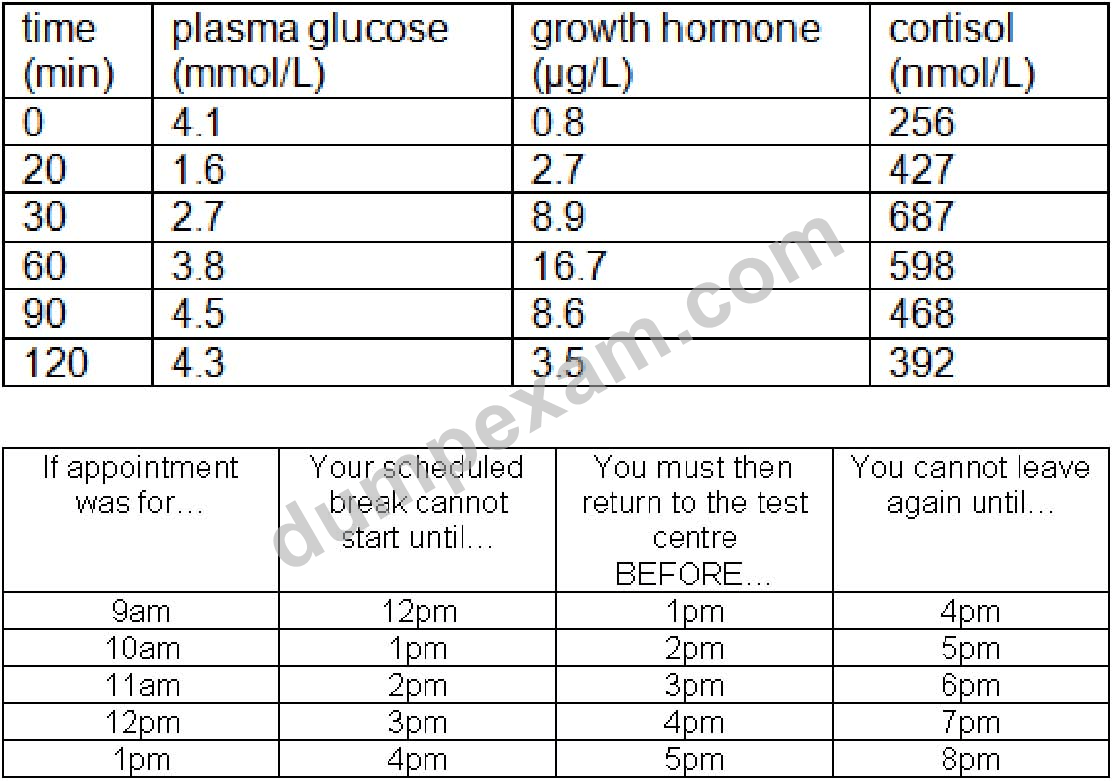
What is the most appropriate treatment?
A. growth hormone 0.4 mg subcutaneously per day
B. testosterone 50 mg intramuscularly per month
C. hydrocortisone 15 mg am, 5 mg pm
D. testosterone 250 mg intramuscularly per month
E. reassure and review
Question 3
A 32-year-old woman with a recurrent history of Graves' thyrotoxicosis was being considered for radioiodine treatment. However, she wanted to conceive again at some stage and asked how soon she could become pregnant.
After what minimum interval would it be safe for her to conceive again?
A. 6 months
B. 12 months
C. 8 months
D. 2 months
E. 4 months
Question 4
A 63-year-old woman with diet-controlled type 2 diabetes mellitus was admitted with biventricular cardiac failure. She had a history of myocardial infarction 3 years previously. She was taking aspirin 75 mg daily, simvastatin 20 mg daily, furosemide 40 mg daily and ramipril 10 mg daily. She responded well to increased diuretic therapy.
Urinalysis showed glucose 1+.
Investigations:
haemoglobin112 g/L (115-165)
serum sodium135 mmol/L (137-144)
serum potassium4.7 mmol/L (3.5-4.9)
serum creatinine162 umol/L (60-110)
estimated glomerular filtration rate28 mL/min/1.73 m2 (>60)
serum troponin T<0.01 ug/L (<0.01)
haemoglobin A1c66 mmol/mol (20-42)
What is the most appropriate treatment for her diabetes after discharge?
A. exenatide
B. gliclazide
C. linagliptin
D. dapagliflozin
E. subcutaneous insulin
Question 5
A 40-year-old man presented with a 4-month history of increasing central obesity. His medical history included HIV infection and allergic rhinitis. He was taking highly active antiretroviral therapy and nasal fluticasone.
On examination, he had marked central adiposity. His blood pressure was 160/95 mmHg.
Investigations:
serum sodium140 mmol/L (137-144)
serum potassium3.8 mmol/L (3.5-4.9)
serum cholesterol5.5 mmol/L (<5.2)
fasting serum triglycerides8.20 mmol/L (0.45-1.69)
serum cortisol (09.00 h)<50 nmol/L (200-700)
serum thyroid-stimulating hormone4.6 mU/L (0.4-5.0)
serum free T49.3 pmol/L (10.0-22.0)
What is the most likely diagnosis?
A. hypothyroidism
B. HIV-associated lipodystrophy
C. glucocorticoid resistance
D. Addison's disease
E. Cushing's syndrome
Solutions:
| Question 1 Answer: A | Question 2 Answer: B | Question 3 Answer: A | Question 4 Answer: B | Question 5 Answer: E |


 Amanda
 Levi
Levi 
 Cedric
 Saxon
Saxon  Maud
Maud  Webster
  Marvin
  Joshua
  Mirabelle
  Mark
Mark  Nicola
  Luther
  Joshua
  Everley
  Thomas
  Leopold
  Juliet
  Steven
  Martina


